
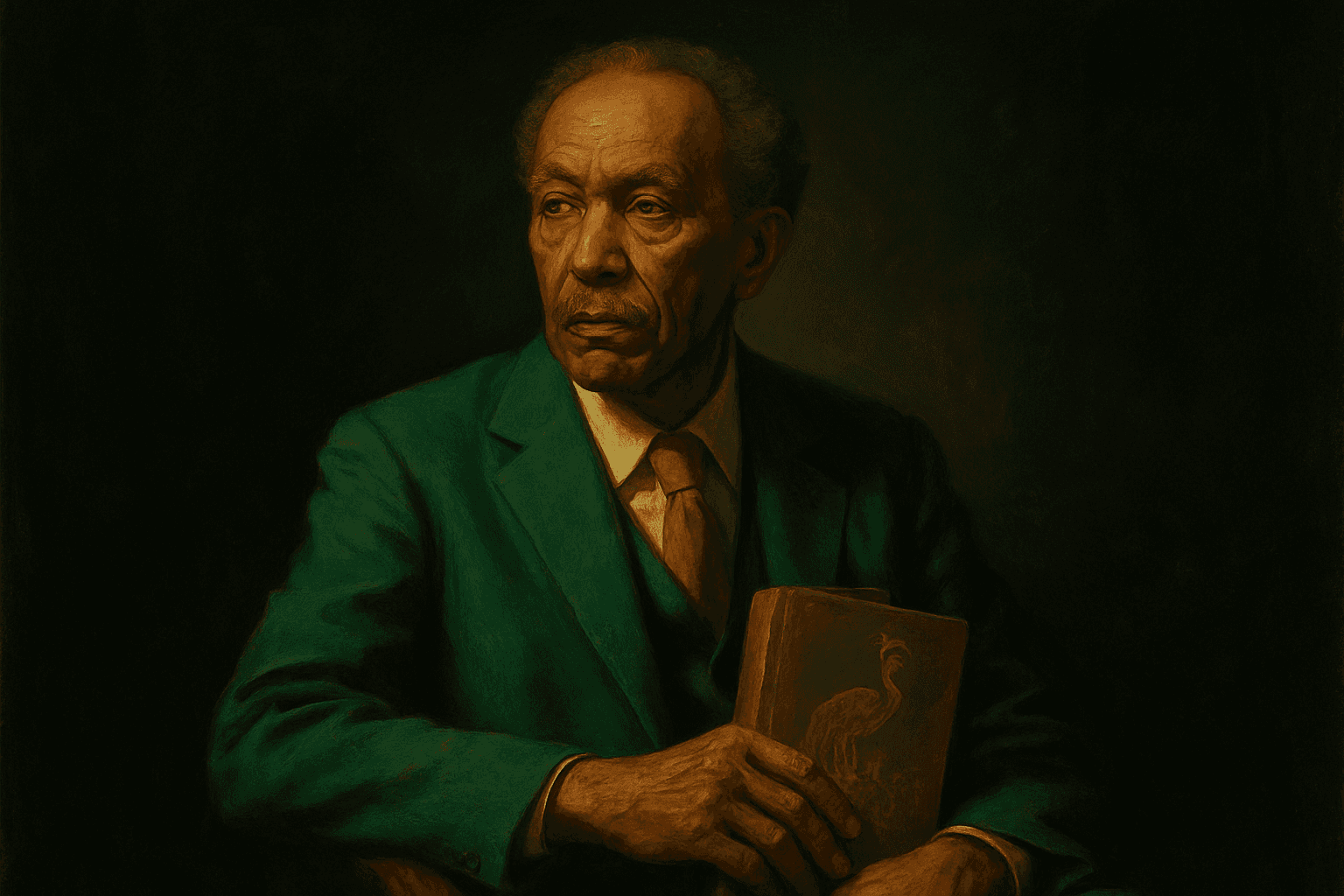
Wilson Harris and the Palace of the Peacock
The Guyanese novelist who bent the English language until it could hold the rainforest, the river, and the dead.
By Denise
Wilson Harris died in 2018, aged 96, in a flat in Chelmsford. He had lived in England since 1959. He never went back to Guyana.
But Guyana never left his work. The interior — the rivers, the Amerindian settlements, the bush camps — runs through every novel he wrote. He surveyed the hinterland in the 1940s and 50s, before he was a novelist, before he was anything but a young man with a theodolite and a crew. He walked the Potaro, the Mazaruni, the Cuyuni. He saw things that stayed.
His first novel, Palace of the Peacock, came out in 1960. It is not an easy book. The sentences do not behave. The narrative loops, doubles back, refuses to settle. A crew of men pole a boat upriver. They die. They rise. They die again. The river is the Potaro. The river is everywhere. The crew are Amerindian, African, European, mixed. They are also ghosts, or becoming ghosts, or were always ghosts.
Harris called it "the literature of the imagination". He meant something specific. He meant a literature that could hold the fractures of Guyana — the colonial wound, the erasures, the silences — without pretending they were healed. He did not write realism. Realism, he said, could not hold what had happened here. You needed myth. You needed the dead to speak.
The British literary establishment did not know what to do with him. He won no major prizes. He was shortlisted for the Booker once, in 1983, for The Angel at the Gate. He did not win. V.S. Naipaul won Bookers. Wilson Harris did not. This tells you something about what the establishment wanted from the Caribbean: clarity, irony, a certain kind of distance. Harris gave them none of that. He gave them the forest, the river, the dead crew still rowing.
He kept writing. Twenty-four novels. Essays. Lectures. He taught at universities — Newcastle, Texas, Yale. He married Margaret Whitaker, a Scottish writer, in 1959. She typed his manuscripts. She read every draft. When she died in 2011, he was 89. He kept writing.
There is a phrase he used often: "the unfinished genesis of the imagination". He meant that the story of Guyana — of the Caribbean, of the Americas — was not over. Could not be over. The wound was still open. The dead were still speaking. The crew was still rowing upriver.
You will not find Wilson Harris on school syllabuses in Guyana. You will not find him in most bookshops. But he is there, in the hinterland, in the way the light moves on the Potaro, in the way the forest swallows sound. He bent the English language until it could hold all of that. He made it work.
He never went back. But he never left.
Get the next drop in your inbox.
Three drops a week. Wednesdays, Saturdays, Sundays. Edited by Denise.
One email per drop. Unsubscribe any time. We never share your address.