
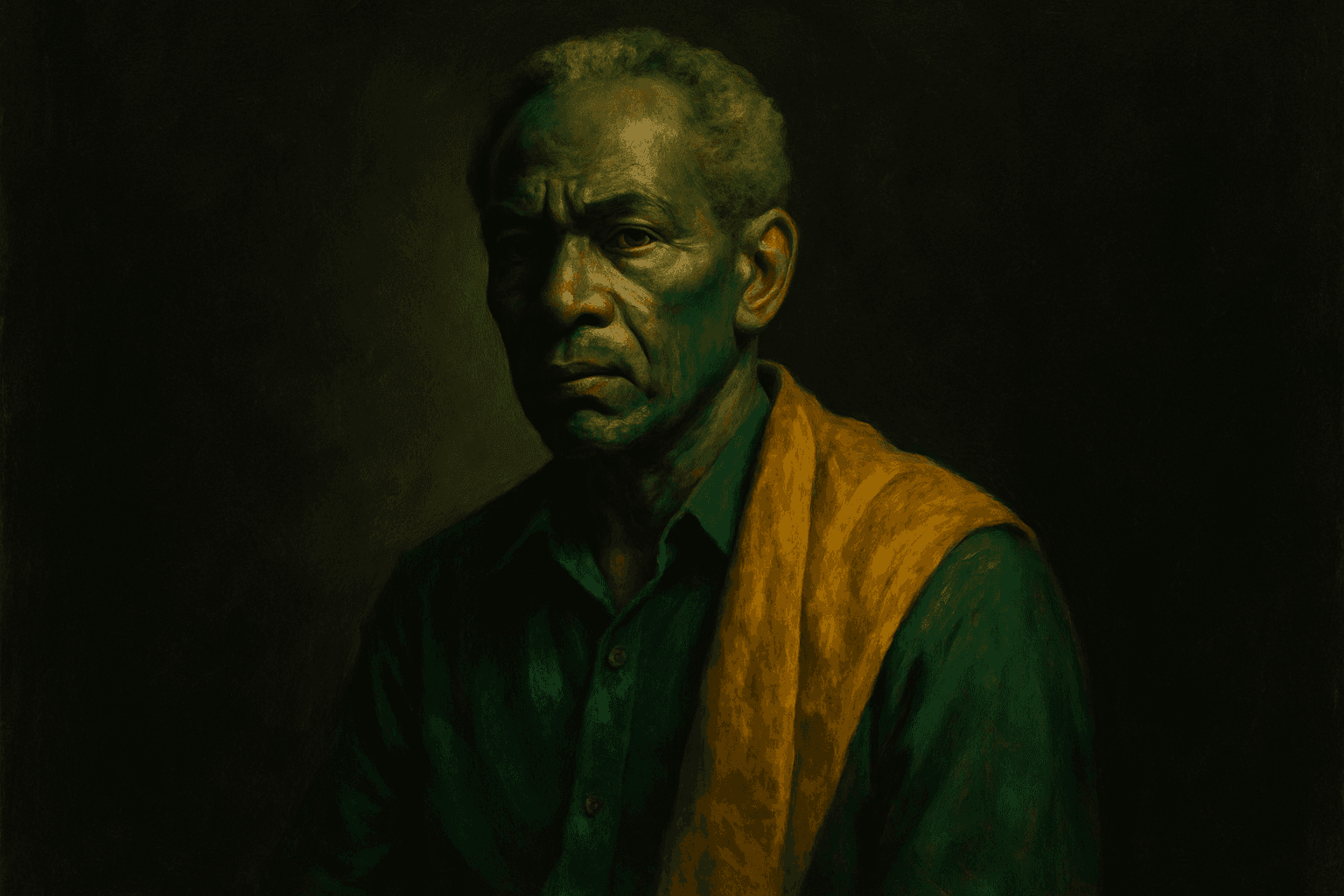
Martin Carter wrote poems that could stop a government
The poet who turned verse into revolution, then revolution into verse again.
By Denise
Georgetown, 1953. Martin Carter was twenty-eight and working as a civil servant when he wrote the poem that would make the colonial government nervous. "I come from the nigger yard of yesterday," it began, and it did not soften from there.
The British arrested him anyway. Not for the poem — for politics. Carter had joined the People's Progressive Party, Cheddi Jagan's movement, and when the British suspended the constitution and declared a state of emergency, Carter went to prison. He was there for four months. He came out with Poems of Resistance from British Guiana.
The poems were not metaphors. "This is the dark time, my love," he wrote, and named the boots in the street, the watchers at the door, the brown beetles in khaki. He was writing about 1953, but he was also writing about every place where power arrives with a curfew.
Carter's lines moved like chants. "All are involved! All are consumed!" The repetition was deliberate — these were poems meant to be read aloud, in yards, at meetings, anywhere people gathered to remember they were not alone. And they were. For years, if you were Guyanese and political, you knew Carter's poems before you knew his face.
But here is the turn. In 1966, Guyana got independence. Carter became a minister in the new government. The poet who had written against power now held it. He lasted two years. By 1970, he had resigned. The revolution he had imagined was not the government he was serving.
He went back to poetry. The later work is quieter, more interior. He wrote about his mother, about Georgetown's canals, about the difficulty of living in a country that had changed but not in the ways he had hoped. "I am no soldier," he wrote. "I have no gun." The defiance was still there, but it had turned inward.
Carter kept writing until he died in 1997. By then, he had published eight collections. The early resistance poems are still the ones people quote, but the later work is where you see the cost. Revolution is loud. Aftermath is not.
He is buried in Georgetown, in the city he never stopped writing about. There is a street named for him now. The government that once jailed him eventually honoured him. Whether he would have wanted that is another question.
What remains is the work. Carter proved that a poem could be a weapon, and then he proved that a weapon could become a mirror. He wrote his way into history, and then he wrote his way past it. Not many poets get to do both.
If you are Guyanese and you have never read Carter, start with "I Come from the Nigger Yard." Then read "This is the Dark Time, My Love." Then read the rest. He wrote for you, whether you were born yet or not.
Get the next drop in your inbox.
Three drops a week. Wednesdays, Saturdays, Sundays. Edited by Denise.
One email per drop. Unsubscribe any time. We never share your address.